Debt Consolidation
Which Is Better, Debt Settlement or Debt Consolidation in Philippines?
When debt gets heavy, you try to find the solution. Borrowing again is not the solution, so you keep looking on Google or other sources. Finally, you come into two solutions: debt consolidation and debt settlement, yet you are confused with it. Don’t worry, you come to the best place to explain the pros and cons of each of them.
💡 Highlights
- Debt consolidation combines your debts into one payment, and you still pay back the full amount, just in an easier way.
- Debt settlement means negotiating to pay less than the full amount you owe, usually as a lump sum.
- Consolidation is usually better when you can still afford to pay, but you are drowning in many due dates.
- Settlement is usually for people who genuinely cannot pay in full and are often already behind.
- Consolidation is gentler on your credit record. Settlement reduces what you owe but leaves a heavier mark.
- Neither is “better” in general. The right one depends on whether you can still realistically pay your full debt.
- A debt resolution facilitator can look at your numbers and tell you which path actually fits you.
What Is the Main Difference Between the Two?
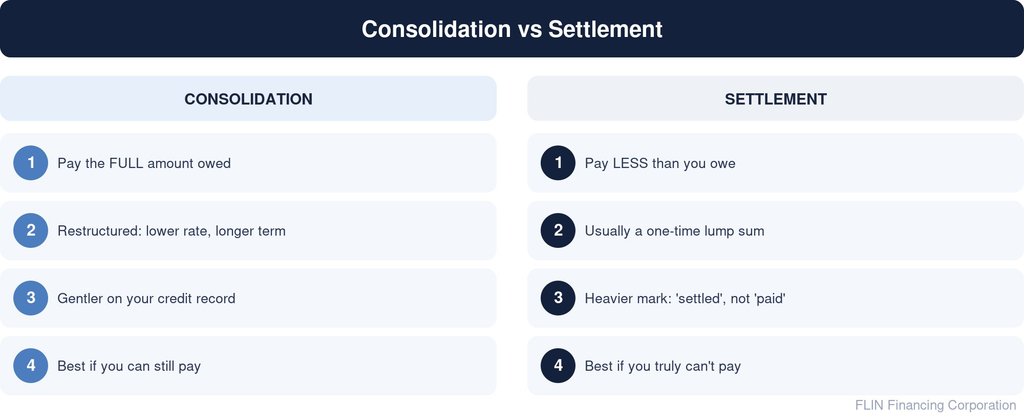
With debt consolidation, you pay the full amount you owe, just restructured to be easier and cheaper over time. You are basically saying, “I can pay this, I just need it organized and manageable.”
With debt settlement, you pay less than the full amount, but only because you truly cannot pay it all. You are basically saying, “I genuinely cannot pay this in full, so let us agree on a smaller amount to close it.”
Which One Is Better for You?
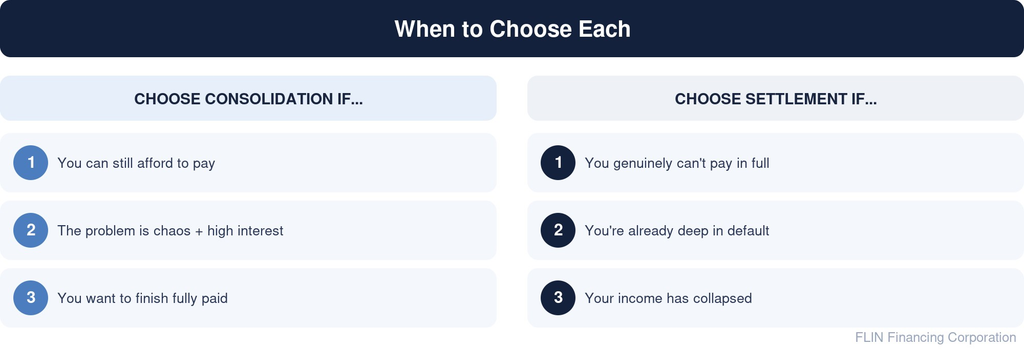
Debt consolidation is usually better if you can still afford to pay. If your income can still cover your debts, but the problem is the chaos of too many due dates and high interest eating you alive, consolidation is almost always the smarter choice. It simplifies your life, lowers your interest, and gets you out fully paid, without the heavier credit damage that settlement brings.
Debt settlement is usually better if you genuinely cannot pay in full. If your situation is severe, you are already deep in default, your income has collapsed, and there is truly no way you can repay the whole amount, then settling for a reduced lump sum may be the realistic path. It is a way to close a debt that would otherwise haunt you for years.
So ask yourself honestly: can I still pay my full debt if it were reorganized into something manageable?
How Does Each One Affect Your Credit?
This is an important and honest point, because it often tips the decision.
Debt consolidation is gentler on your credit record. Because you are still paying your debts in full, just in a restructured way, and making steady on-time payments, it can actually help rebuild your credit over time.
Meanwhile, debt settlement leaves a heavier mark. Because you paid less than the full amount, the debt is usually recorded as “settled” rather than “paid in full,” and lenders can see that. It signals that you could not fully repay, which can make future borrowing harder for a while.
Which One is Good For Me?
Sometimes, yes. Everyone’s debt situation is different, and it is possible that some of your debts are best consolidated while one or two, perhaps the ones already deep in default, are better settled. There is no rule that says you must pick just one approach for everything.
This is exactly why it helps to have someone look at your full picture rather than guessing. The best strategy often mixes the two, matching each debt to the approach that fits it. Or, you can come to FLIN, the best solution for debt consolidation.
FLIN looks at your whole situation and helps figure out which path genuinely fits, whether that is consolidating your debts into one manageable plan and giving you an educational consultation to help you get out of debt. A short, no-pressure chat is enough to see what makes sense for you. Get free from your debt with a single solution from FLIN, which is easy to do.
If you are still confused about the benefits of them, check the following articles:
Your Debt-Free Life Start Here
Consult with us and get the best solution based on your financial condition