Debt Consolidation
What Happens If You Default on a Government Loan in the Philippines?
Missing payments on your SSS, GSIS, or Pag-IBIG loan feels scary, but here is some relief right away: government salary loans are usually far gentler on you than private lenders or loan apps. Still, default does have real consequences, and the smart move is to understand them so you can fix things early.
This guide explains exactly what happens when you default on a government salary loan, and the good news about how to recover. Plain language, made for regular working people.
💡 Highlights
- Government loans are normally paid through automatic salary deduction, so default often happens after you leave a job.
- Defaulting adds penalties and interest, and the unpaid balance can be taken from your future benefits or savings.
- With Pag-IBIG, your balance can be offset against your own accumulated savings, and a housing loan default can lead to foreclosure.
- Defaulting also blocks you from getting new government loans until you settle.
- You cannot be jailed for it, and government agencies do not harass you the way illegal apps do.
- The best news: SSS and Pag-IBIG regularly offer penalty condonation programs that waive your penalties.
- Restructuring is also available, so a stuck loan can almost always be brought back to normal.
What Counts as Defaulting on a Government Salary Loan?
While you are employed, your SSS, GSIS, or Pag-IBIG loan is normally deducted straight from your salary by your employer, so you rarely miss a payment. Default usually happens when that automatic deduction stops, most often when you resign, get separated from your job, or become self-employed and forget to keep paying on your own.
Once payments stop coming in and the arrears build up, the loan is considered past due, and the agency’s rules on penalties and collection kick in. So if you recently left a job with an outstanding government loan, this is the moment to pay attention.
What Happens If You Default on an SSS Salary Loan?
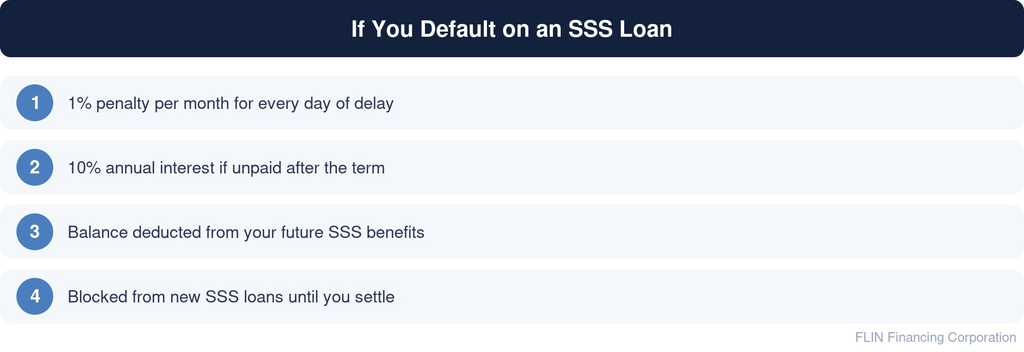
The SSS has clear, published rules. As stated on the SSS website, a late salary loan amortization carries a penalty of 1 percent per month for every day of delay. And if the loan stays unpaid after its term, it accrues 10 percent annual interest plus that 1 percent monthly penalty until fully settled.
Here is the part people do not expect. According to the SSS, once the loan becomes due and demandable, the outstanding balance, including interest and penalties, can be deducted from your future SSS benefit claims. That means it can be taken from your sickness, maternity, disability, retirement, or even death benefits, and in some cases from the benefits of your beneficiaries. On top of that, you are temporarily disqualified from taking any new SSS loan until you settle. So an unpaid SSS loan does not just disappear, it quietly waits and gets collected from what you are owed later.
What Happens If You Default on a Pag-IBIG Loan?
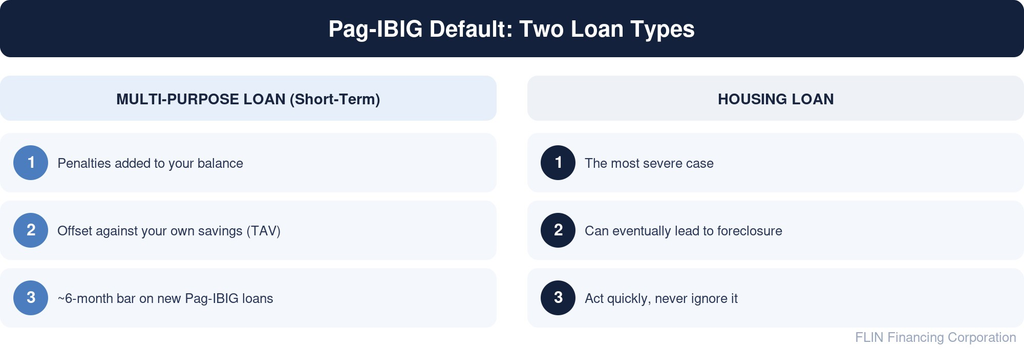
Pag-IBIG works a little differently, and the consequences depend on the loan type. As explained in Philippine legal guidance from lawyer-philippines.com, defaulting on a Pag-IBIG short-term loan like a Multi-Purpose Loan triggers penalties, and importantly, Pag-IBIG can issue a Notice of Offset and net your outstanding balance against your Total Accumulated Value, which is basically your own Pag-IBIG savings. You also get suspended from availing new Pag-IBIG loans, with a bar of around six months after a short-term loan default.
For a Pag-IBIG housing loan, the stakes are much higher. As that same guidance notes, a housing loan default is the most severe case, because it can eventually lead to foreclosure and the loss of your home. So while a small Multi-Purpose Loan default is manageable, a housing loan default is something to act on quickly and never ignore.
What About GSIS Loans?
If you are a government employee, your GSIS loans work on the same basic logic. They are repaid through salary deduction, and defaulting adds penalties and interest, blocks you from new loans, and lets GSIS collect the unpaid balance from your benefits or claim proceeds down the line. Like the other agencies, GSIS also periodically offers restructuring and condonation programs to help members recover.
Will Defaulting Land You in Jail or Get You Harassed?
No on both counts, and this is worth holding onto. A government salary loan is a civil obligation, not a crime, so you cannot be imprisoned for failing to pay it, the same protection that applies to any ordinary loan under Article III, Section 20 of the 1987 Constitution. Government agencies use their own administrative collection, offsetting, deduction, and recovery procedures. The specific consequences depend on the agency and loan program.
Is There a Way to Fix a Defaulted Government Loan?
Yes, and this is the best part. Government agencies actually want you to recover, so they regularly offer relief.
The biggest one is penalty condonation. As announced by the SSS in 2026 (Philippine Information Agency; Philippine News Agency), it offers a Consolidation of Past Due Short-Term Member Loans with Condonation of Penalty program, where your past-due salary, calamity, and emergency loans are combined into one consolidated loan, and 100 percent of the penalties are waived once you pay off the consolidated amount. Pag-IBIG runs similar penalty condonation programs periodically too, as noted in Philippine legal guidance.
The other option is restructuring, where the agency reworks your loan into terms you can manage. As explained in guidance on Pag-IBIG, these programs are not automatic rights, so you have to apply and get the approved terms in writing, but they are very real lifelines. Between condonation and restructuring, a defaulted government loan can almost always be brought back to good standing.
What Should You Do If You Cannot Pay?
Act early, because the sooner you move, the more relief is available. First, do not just go silent, since ignoring it only lets penalties and offsets pile up. Contact the agency directly, through your My.SSS or Pag-IBIG online account, and ask which current condonation or restructuring program you qualify for. Apply while a condonation window is open, since these come and go. And always get the approved terms in writing before you agree.
One note: this article is general information, not legal advice. For a complicated case, especially a housing loan facing foreclosure, you can also seek free legal help from the Public Attorney’s Office if you qualify.
But if the real problem is that debt from many directions has outgrown your salary, FLIN can help with the bigger picture. FLIN helps salaried Filipinos combine high-interest debts, online loans, credit cards, and buy-now-pay-later balances, into one more manageable monthly payment.
A short, no-pressure consultation can help you see how all the pieces fit together and what a workable plan looks like. Defaulting on a government loan feels heavy, but between the agencies’ relief programs and a clear plan for the rest, it is very much something you can recover from. Click below for free consultation!
Find other article how to manage debt properly :
Your Debt-Free Life Start Here
Consult with us and get the best solution based on your financial condition