
Debt Consolidation
What Happens to Unpaid Credit Card Debt in the Philippines After Months or Years?
You missed a payment. Then another. Now you lie awake wondering what actually happens next. Will they take your things? Will you go to jail? Will it just disappear if you wait long enough? These are among the most searched, most worried-about questions in the Philippines, so let’s walk through exactly what happens to unpaid credit card debt over time, month by month and year by year.
Plain language, made for regular working people, so you can stop guessing and start planning.
💡 Highlights
- Missing payments does not send you to jail. Credit card debt is a civil matter, not a crime.
- After about 3 months, your account becomes delinquent and can be flagged across banks.
- After around six months, the bank usually writes it off and hands it to a collection agency.
- Your unpaid debt goes on your credit record and can follow you into future loan and card applications.
- Interest and penalties keep growing the whole time, so the balance gets bigger, not smaller.
- The debt does not magically vanish after 7 years. The Philippines uses a different rule called prescription.
- Ignoring it is almost never the cheapest path, but there are real ways to fix it at any stage.
What Happens in the First Few Months?
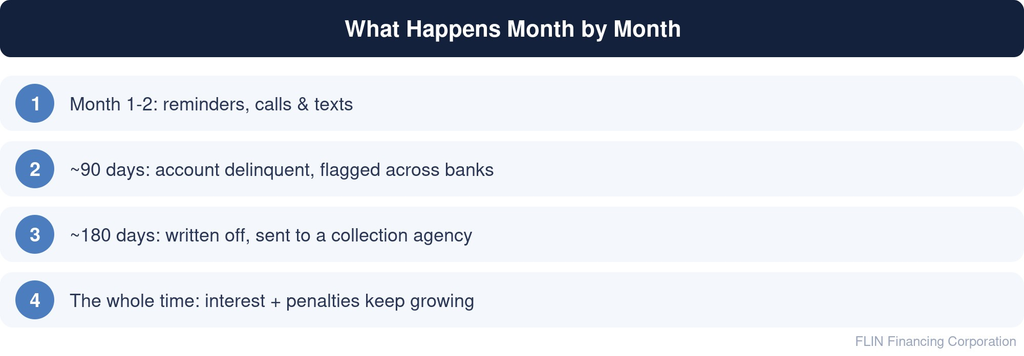
Once you have missed your minimum payment for about two billing cycles, roughly 90 days, your account is officially considered delinquent. At this point, your status can be shared among financial institutions, which quietly makes it harder to get new loans or cards, even from banks you don’t owe. The calls usually pick up here too.
Then, at around 180 days, or about six months, the bank typically writes off the debt as a loss on their books and hands your account over to a collection agency. This does not mean the debt is forgiven. It just means a new, often more aggressive team starts calling. This is usually when the pressure feels heaviest.
What Happens to My Credit Record?
That record follows you. A trail of unpaid balances can quietly hurt you the next time you apply for a car loan, a housing loan, or even a new credit card, sometimes for years. This is the real, lasting cost of leaving a debt unpaid, and it is exactly why hiding from it rarely turns out to be the cheapest choice in the long run.
Does the Debt Keep Growing?
Yes, and this is important. While you are not paying, the debt does not sit still. Interest and penalties keep piling on top of your balance. In the Philippines, banks can charge up to 3 percent interest per month on unpaid balances, and that stacks month after month, plus late fees.
So the longer a balance goes unpaid, the bigger it grows. What started as a manageable amount can quietly balloon into something much larger over a year or two. This is the quiet math that catches people off guard, and it is why acting sooner almost always costs less than waiting.
What Happens After Several Years? Does It Ever Disappear?
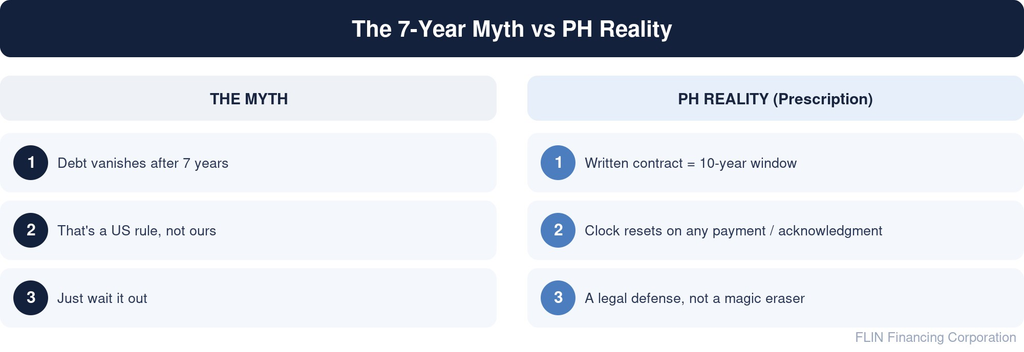
Here is the myth that traps a lot of people. Many believe that after 7 years, credit card debt just disappears. That idea comes from the United States and does not apply here. The Philippines runs on a different concept called prescription.
It resets to zero every time the debt is acknowledged, whether through a partial payment, a signed promise to pay, or sometimes even responding to a demand in the wrong way. So the plan of “just wait it out” is far weaker than it sounds, because a single small payment or acknowledgment can restart the entire 10-year period. Prescription is a legal defense, not a magic eraser, and the debt still sits on your conscience and your credit record in the meantime as cited here.
What Can Legally Happen to Me?
Let’s be clear about the real worst case, so the fear doesn’t run wild. The most a lender can lawfully do is file a civil case to recover the money. For amounts up to one million pesos, this usually goes through a simplified small claims process where lawyers are not even allowed to argue.
If the court agrees you owe the money, it issues a judgment ordering you to pay, sometimes on a schedule. Only after that, and through a court officer, can they try to collect from certain assets, and even then the law protects your basic necessities. There is no scenario in an ordinary unpaid credit card case that ends in jail. It ends, at most, in an order to pay.
Can Collectors Harass Me the Whole Time?
No, and knowing this protects you. No matter how far behind you are, collectors are not allowed to threaten you, curse at you, shame you on social media, or contact your family, friends, and officemates to embarrass you into paying. Those tactics are against the law.
If a collector crosses these lines, stay calm, save the evidence, and report them to the BSP, the SEC, or the National Privacy Commission. Falling behind on a bill does not strip you of your rights, and it does not make you a fugitive.
What Should I Do About Unpaid Credit Card Debt?
The honest bottom line: the debt will not disappear on its own, it grows while you ignore it, and it quietly damages your credit the whole time. So the smartest move is to face it, at whatever stage you are in. Doing something is almost always cheaper than doing nothing.
You can call the bank and ask to restructure the balance into a lower, fixed installment. You can consolidate it with your other debts into one manageable payment. Or, if you are juggling several loans, FLIN will help you with the debt consolidation program.
In this case, FLIN helps you to merge all loans into one. It’s easy-to-manage with longer tenure. Then, you can manage your finances easily without further problems. Start a debt-free life journey right now by doing free consultation with FLIN.
Find out more about tips in managing your credit card loan via articles below:
Your Debt-Free Life Start Here
Consult with us and get the best solution based on your financial condition