
Uncategorized
What Is a Healthy Debt-to-Income Ratio in the Philippines?

If you are planning to apply for a loan or other form of credit, lenders may assess your debt-to-income ratio (DTI) to understand how much of your income is already committed to debt payments. But what exactly is DTI, how do you calculate it, and what is considered a healthy range in the Philippines? this article will tell you more about it below.
💡 Highlights
- Your debt-to-income ratio, or DTI, is how much of your monthly income goes to paying debts.
- To compute it, divide your total monthly debt payments by your gross monthly income, then multiply by 100.
- A healthy DTI is generally 36 percent or below, and lower is better.
- Once your DTI climbs past around 40 to 43 percent, borrowing gets harder and money gets tight.
- A high DTI is often the earliest warning sign that you are heading toward a debt trap.
- You can lower your DTI by paying down debt, boosting income, or restructuring what you owe.
- DTI is considered as one of crucial factors to decide whether you are eligible or not to take a credit.
What Is a Debt-to-Income Ratio?
Your debt-to-income ratio is simply the share of your monthly income that gets eaten up by debt payments. It is a quick way to measure how stretched your finances really are.
Think of it like this. If a big chunk of your salary is already promised to loans and credit cards before you even buy food or pay rent, your DTI is high, and your money is tight. If only a small slice goes to debt, your DTI is low, and you have breathing room. It is one of the clearest, most honest numbers about your financial health, which is exactly why lenders rely on it so much.
How Do You Compute Your Debt-to-Income Ratio?
It is really easy to count it by this formula:
DTI = (Total Monthly Debt Payments ÷ Gross Monthly Income) × 100
- First, add up all your monthly debt payments. That means your loan installments, credit card minimums, car or motorcycle financing, salary loan deductions, and app loan payments.
- Then take your gross monthly income, which is your income before taxes and deductions.
- Divide the first by the second, and multiply by 100 to get a percentage.
For example :
If your monthly debt payments add up to 20,000 pesos and your gross monthly income is 50,000 pesos, then 20,000 divided by 50,000 is 0.4, times 100 equals 40 percent. That means 40 percent of your income is going to debt.
What Is a Healthy Debt-to-Income Ratio?
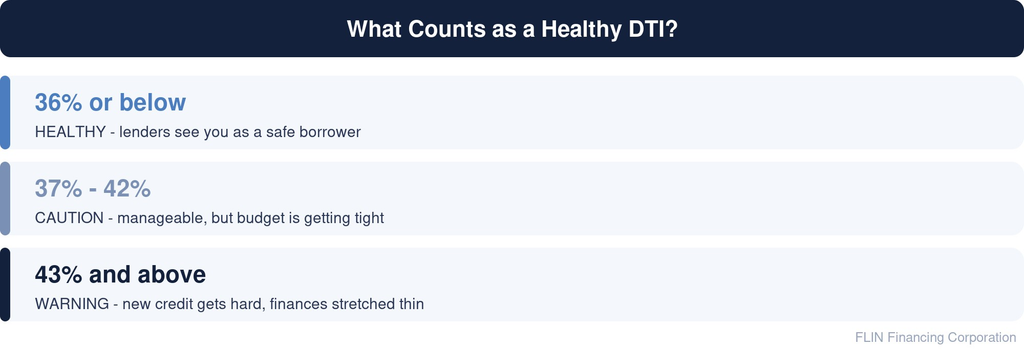
Here is the answer you came for. As a general rule, a healthy debt-to-income ratio is 36 percent or below, and the lower it is, the better your financial health. Lenders like to see that most of your income is free, not already committed to debt as cited here.
Here is a simple way to read your number:
- 36 percent or below is healthy. You are in good shape, and lenders see you as a safe borrower.
- 37 to 42 percent is caution territory. It is manageable, but your budget is getting tight and there is little room for surprises.
- 43 percent and above is a warning sign. Many lenders become reluctant to approve new credit here, and your finances are stretched thin.
Ideally, you also want as little of that debt as possible tied up in high-interest borrowing like credit cards and app loans. So the target is simple: keep your total monthly debt payments to about a third of your income, and you are in a genuinely healthy spot.
Why Does Your Debt-to-Income Ratio Matter?
Here are some reasons why DTI is very important for your credit:
- First, it decides whether you get approved for loans. When you apply for a personal loan, a car loan, or a housing loan, lenders look at your DTI to judge whether you can afford another payment. If yours is already high, they may reject you or offer worse terms, because they see you as risky.
- Second, and more importantly, it is an early warning system for you. A rising DTI is often the very first sign that a manageable debt load is quietly turning into a debt trap. Long before you actually miss a payment, your DTI is already flashing yellow. So checking it regularly is one of the smartest financial habits you can build.
What if My Debt-to-Income Ratio Is Too High?
First, do not panic. A high DTI is a signal, not a sentence, and there are clear ways to bring it down.
You can lower the top number by reducing your debt. Pay down your balances, starting with the highest-interest ones, so your monthly payments shrink. And crucially, stop taking on new debt, since every new loan pushes your DTI back up.
You can raise the bottom number by increasing your income. A sideline, overtime, or extra work adds to your income and lowers the ratio, as long as you send that extra money to debt and not to new spending.
And there is a shortcut when the ratio is high because your payments are simply too big: restructuring or consolidation. By combining your debts into one plan with a longer term and lower interest, your total monthly payment drops, which directly lowers your DTI and frees up room in your budget, without you needing to instantly earn more or pay off huge chunks overnight.
Getting Your Ratio Back to Healthy
If you have done the math and your debt-to-income ratio is uncomfortably high, especially if it is well past 40 percent, that is worth taking seriously. It usually means your monthly payments have grown beyond what your income can comfortably carry, and no amount of budgeting alone will fully fix a problem that is really about the size and structure of the debt.
If a large portion of your income is already going toward multiple debt payments, debt consolidation may be an option worth exploring.
FLIN helps eligible borrowers review their existing debts and understand whether debt consolidation may be suitable for their financial situation. Depending on your eligibility and the debts involved, eligible loans may be combined into a more structured repayment arrangement with a tenure of up to 36 months.
Start with a free consultation to understand your options before deciding.
Your Debt-Free Life Start Here
Consult with us and get the best solution based on your financial condition