
Debt Solution
Can You Leave the Country If You Have Unpaid Credit Card Debt in the Philippines?

Planning a trip abroad but worried your unpaid credit card might get you stopped at the airport? Here is the short, reassuring answer: in almost all cases, yes, you can leave the country. Unpaid credit card debt does not put you on any no-fly list, and no bank can block you at immigration.
This guide explains why, when the rare exception actually applies, and why those “you’ll be blacklisted at the airport” threats from collectors are usually just scare tactics. Plain language, made for regular working people.
💡 Highlights
- Unpaid credit card debt alone does not stop you from leaving the Philippines.
- Credit card debt is a civil matter, not a crime, and your right to travel is protected by the Constitution.
- The Bureau of Immigration does not check your credit card balances and has no database of delinquent debtors.
- Only a court-issued Hold Departure Order can bar you from leaving, and those come only from criminal cases.
- A bank or collector cannot put you on a watchlist or stop you at the airport for a civil debt.
- The only way card debt could affect travel is if it turned into a criminal case, like a bounced check or fraud.
- Leaving the country does not erase the debt, so it still needs a plan.
Can Unpaid Credit Card Debt Stop You at the Airport?
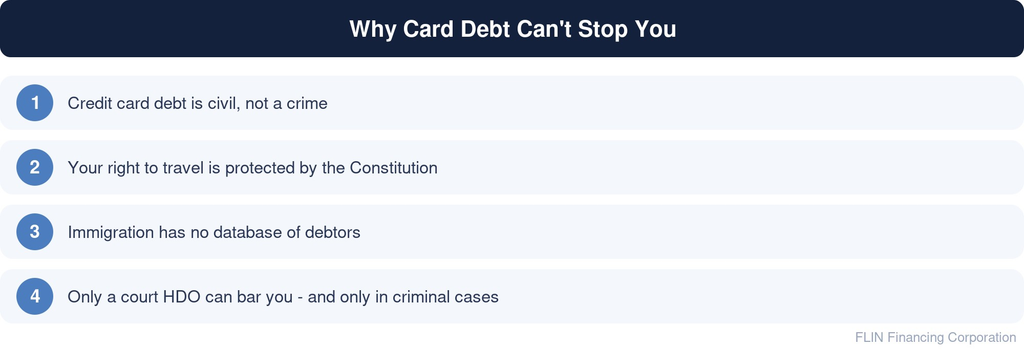
No, not on its own. As confirmed by multiple Philippine legal sources including Respicio and Co., having unpaid credit card debt alone will not get you stopped at immigration. Immigration officers check whether you have valid travel documents and whether there is any legal order against you. They do not pull up your credit card balance, because they simply do not have that information.
Why Can’t a Bank Stop You From Leaving?
Because of the basic difference between civil and criminal matters. Unpaid credit card debt is a civil liability, meaning it is a money dispute between you and the bank, not a crime. Your right to travel is guaranteed by the Constitution, and as Philippine legal guidance explains, that right can only be curtailed in specific, legally defined circumstances, which a simple debt does not meet.
A private bank has no power to put you on any list. As legal guidance from lawyer-philippines.com states, credit card companies cannot unilaterally prevent you from traveling, and without a court-issued hold order, you can travel freely. The Bureau of Immigration keeps no list of people who owe banks money.
What Is a Hold Departure Order, and When Does It Happen?
A Hold Departure Order, or HDO, is the thing people actually fear, so let us be clear about it. As explained in Philippine legal sources, an HDO is a court order that directs the Bureau of Immigration to stop a specific person from leaving the country. Along with a Watchlist Order and an Immigration Lookout Bulletin Order, these are the only instruments that can legally restrict your travel, and they are governed by DOJ rules.
The crucial point: these are issued only in criminal cases. As Respicio and Co. notes, for an HDO to exist, a criminal case must have been filed and a judge must find you a flight risk. Since ordinary credit card debt is civil, an HDO is never issued for a standard unpaid card. Even a judgment against you in a small claims case cannot result in an HDO or a travel ban.
So When Could Credit Card Debt Actually Affect Your Travel?
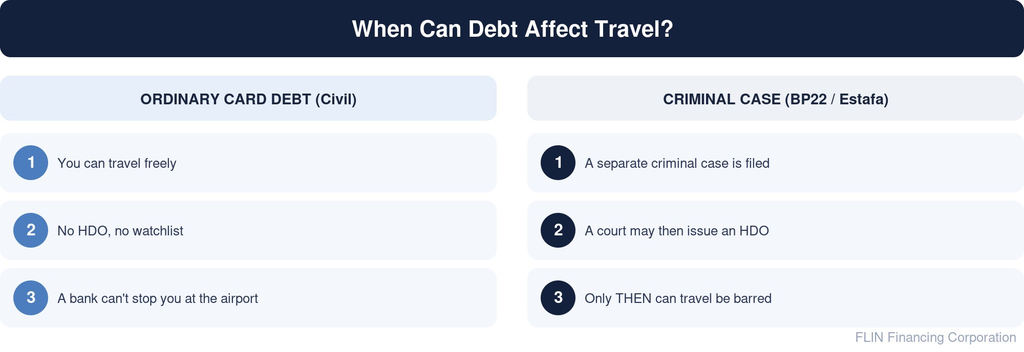
There is one narrow path, and it is worth understanding so you are not caught off guard. Credit card debt can only touch your travel if it crosses from civil into criminal territory. As Philippine legal guidance explains, this happens if the card company files a criminal case for something like a bounced check under the Bouncing Checks Law, or estafa, meaning fraud, and a court in that criminal case then issues a hold departure order.
Notice what that means: it is never the debt itself that restricts you. It is a separate crime, like issuing a check that bounced or obtaining the card through deception. If you simply borrowed honestly and could not pay, that is purely civil, and your travel stays free.
Collectors Are Threatening Me With an Airport Hold. Is That Real?
Almost always, no. This is one of the most common scare tactics, and now you can see why it is hollow. As Philippine legal guidance points out, a bank or collector cannot simply stop you at the airport for a civil credit card balance, and they cannot threaten a hold departure order without a real court or immigration basis.
So when a collector messages you claiming you will be “blacklisted at immigration” or “offloaded at the airport” over an unpaid card, they are bluffing to frighten you into paying. For the record, being “offloaded” by immigration is about screening for human trafficking and illegal recruitment, not about debt. Your card balance has nothing to do with it.
Does Leaving the Country Erase My Debt?
No, and this is the honest flip side. Traveling or even moving abroad does not make the debt disappear. It remains a valid civil obligation. The bank can still file a collection case, the unpaid balance still sits on your credit record through the Credit Information Corporation, and if you are overseas when a case is filed, your assets back in the Philippines can still be pursued.
So while you are free to travel, it is not a way to escape the debt. The smarter approach is to keep the debt on a plan even while you come and go.
What Should You Do?
The practical takeaway is simple. Go ahead and travel if you need to, because a civil card debt will not stop you. But do not ignore the debt itself. If you receive a real court subpoena or order, respond to it, never skip it. And whenever you can, keep your credit card balance on a realistic repayment plan so it does not keep growing in the background.
One note: this article is general information, not legal advice. If a criminal case or court order is actually involved in your situation, talk to a lawyer, and remember that free legal help is available from the Public Attorney’s Office if you qualify.
Handling the Debt So It Stops Hanging Over You
Being free to travel is a relief, but an unpaid card that keeps growing is still a weight you carry everywhere, airport or not. If your credit card balance has climbed past what you can comfortably pay, the answer is not to leave it and hope, because the interest and the record follow you.
FLIN helps salaried Filipinos combine high-interest debts, credit cards, online loans, and buy-now-pay-later balances, into one more manageable monthly payment. A short, no-pressure consultation can help you turn a stressful balance into a clear plan. Don’t hesitate to consult with us by clicking the button below!
Find more articles about how to solve credit card debt via following below:
Your Debt-Free Life Start Here
Consult with us and get the best solution based on your financial condition