Debt Solution
Can the Interest and Penalties on My Unpaid Loan Be Reduced or Waived in the Philippines?
When you fall behind on a loan, the scariest part is often not the original amount, it is watching the interest and penalties pile on top until the balance looks impossible. So here is a genuinely hopeful answer: yes, in many cases the interest and penalties on your loan can be reduced or even waived entirely. There are several real ways to make it happen, and the law actually gives you more protection than most people realize.
💡 Highlights
- Interest and penalties can often be reduced or waived, through negotiation, restructuring, condonation, or the courts.
- Many lenders will waive penalties on their own, especially if you offer to settle or show genuine hardship.
- Government loans like SSS and Pag-IBIG regularly run programs that waive 100 percent of penalties.
- Under the Civil Code, courts can reduce interest and penalties they find excessive or unfair, even if you signed for them.
- If charges were never clearly disclosed to you, they may not be enforceable.
- You usually have to ask, so do not assume the charges are final.
Can Interest and Penalties Really Be Reduced or Waived?
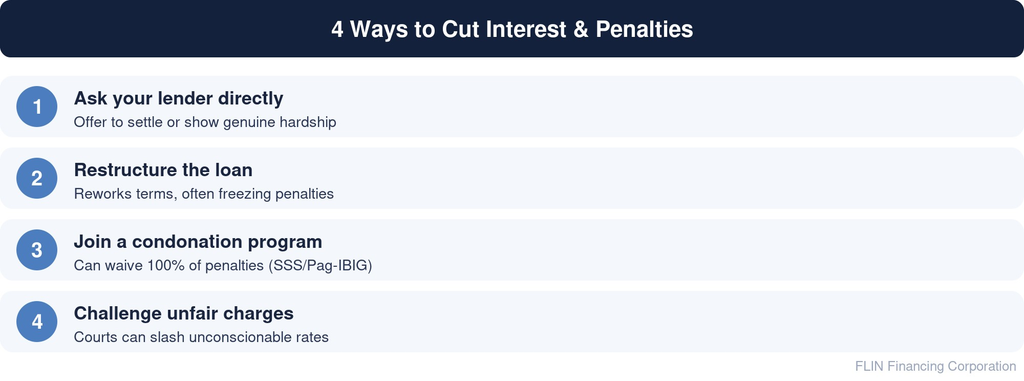
Yes. This surprises a lot of borrowers, but reducing or waiving interest and penalties is common and completely legitimate. It happens through four main routes: negotiating directly with your lender, restructuring the loan, joining a condonation program, or, when the charges are truly unfair, challenging them under the law.
The key thing to understand is that these reductions rarely happen automatically. In most cases, you have to ask. So the worst thing you can do is assume the ballooning number on your statement is final, when very often it is not.
Way 1: Ask Your Lender Directly
Start here, because it is the simplest and works more often than people expect. Lenders would rather recover something than chase you for years, so many are willing to waive penalties as a goodwill gesture, especially if you show genuine intent to pay.
The most effective move is to offer a settlement. If you can pay a lump sum, ask the lender to waive the accumulated penalties in exchange for settling the balance. Show proof of hardship if you have it, like a medical bill or a notice of reduced income. And always get any agreed waiver in writing before you pay. Banks and lenders do this regularly, you just have to open the conversation.
Way 2: Restructure the Loan
Restructuring is a formal arrangement that reworks your loan into terms you can manage, and it very often includes freezing or reducing the penalties that piled up. Instead of watching charges grow while you fall further behind, restructuring stops the bleeding and resets you onto a payment you can actually meet. For many borrowers, this is where a big chunk of the penalties quietly disappears, as part of getting the loan back to normal.
Way 3: Join a Condonation Program
This is one of the most powerful options, especially for government loans. Condonation means the lender formally forgives the penalties.
Government agencies run these regularly. The SSS, for example, has offered programs that combine your past-due loans into one and waive 100 percent of the penalties once you settle the consolidated amount. Pag-IBIG and GSIS run similar penalty condonation programs from time to time. For credit cards, there is also a relief program run with the Credit Card Association of the Philippines that restructures card debt at much lower rates. These windows open and close, so it is worth checking directly with your lender or agency whether one is currently available.
Way 4: If the Interest or Penalty Is Unfair, the Law Is on Your Side
Here is the part most borrowers never learn. Even if you signed the loan agreement, you are not stuck with charges that are outrageously high. Under Article 1229 of the Civil Code of the Philippines, courts have the power to reduce a penalty that is iniquitous or unconscionable, meaning shockingly excessive, even when both parties agreed to it.
The Supreme Court has applied this many times. As Philippine legal sources explain, courts have repeatedly struck down interest rates of 3 to 6 percent per month, which work out to 36 to 72 percent a year, as unconscionable. When that happens, the court throws out the excessive rate and applies the legal interest rate instead, which, following the Supreme Court ruling in Nacar v. Gallery Frames, is currently 6 percent per year. The same power applies to penalty charges. So if a lender is hitting you with punishing interest or penalties, those numbers are not automatically valid, and a court can slash them.
What Counts as “Unconscionable” Interest or a Penalty?
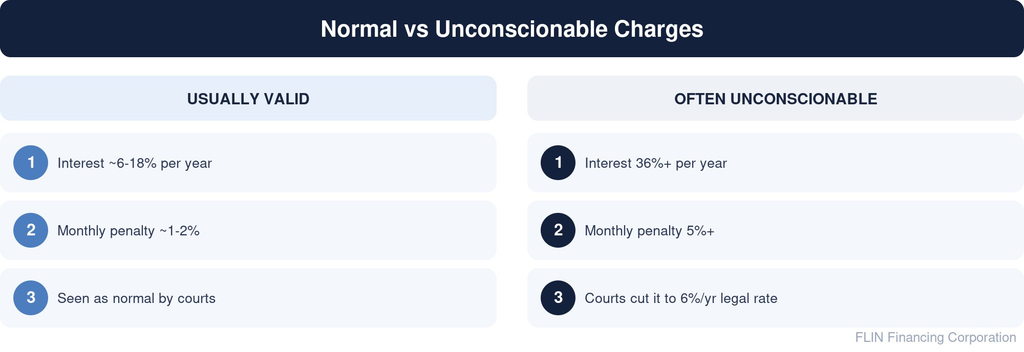
A fair question, since not every high rate qualifies. There is no single fixed cutoff, but Philippine legal guidance offers a rough picture. Interest in the range of roughly 6 to 18 percent a year and a monthly penalty of about 1 to 2 percent are generally seen as normal. But interest climbing to 36 percent a year or more, or a monthly penalty of 5 percent or more, often falls into unconscionable territory and becomes vulnerable to being reduced.
There is also a second angle. Under the Truth in Lending Act, lenders must clearly disclose all the charges before you borrow. If an interest charge, fee, or penalty was never properly disclosed to you, it may be unenforceable. So it is worth checking whether you were ever given a clear, written breakdown of what you were agreeing to.
What About Illegal or Unlicensed Lenders?
If the loan came from an unlicensed lender or a predatory app, your position is even stronger. As noted in legal remedies for excessive loan interest, courts have routinely voided the extreme interest these operators charge, reducing it to the legal rate or, in cases of bad faith, allowing no interest at all. So a lot of what an illegal app claims you owe, especially the interest and penalties, often will not hold up at all.
How Do You Actually Ask for a Reduction?
Here is a simple plan to put this into action. Put your request in writing, so there is a clear record. Explain your situation honestly and show any proof of hardship. If you can, propose a specific lump-sum settlement in exchange for waiving the penalties, or ask directly about restructuring and any current condonation program. If the interest or penalties genuinely look unconscionable, you can raise that as a formal dispute, and there is even a legal tool called consignation, where you deposit the amount you honestly owe with the court to stop further interest and penalties from piling up while the dispute is sorted.
One note: this article is general information, not legal advice. For disputes involving genuinely unfair charges or a court case, talk to a lawyer, and remember that free legal help is available from the Public Attorney’s Office if you qualify.
Negotiating penalties down, sorting out which charges are fair, and combining everything into something you can actually pay is a lot to handle alone, especially when you are already stressed and dealing with several lenders.
FLIN helps salaried Filipinos combine high-interest debts, online loans, credit cards, and buy-now-pay-later balances, into one more manageable monthly payment. A short, no-pressure consultation can help you see which of your charges can realistically be reduced and what a workable plan looks like. Click the button below to get a free consultation now!
Read more how to manage your loan effectively via articles below:
Your Debt-Free Life Start Here
Consult with us and get the best solution based on your financial condition